RESPONSES OF CORN HYBRIDS TO COVER CROPS ON GRAIN YIELD ANDPRODUCTION COSTS
DOI:
https://doi.org/10.18512/ijms2026e1381Abstract
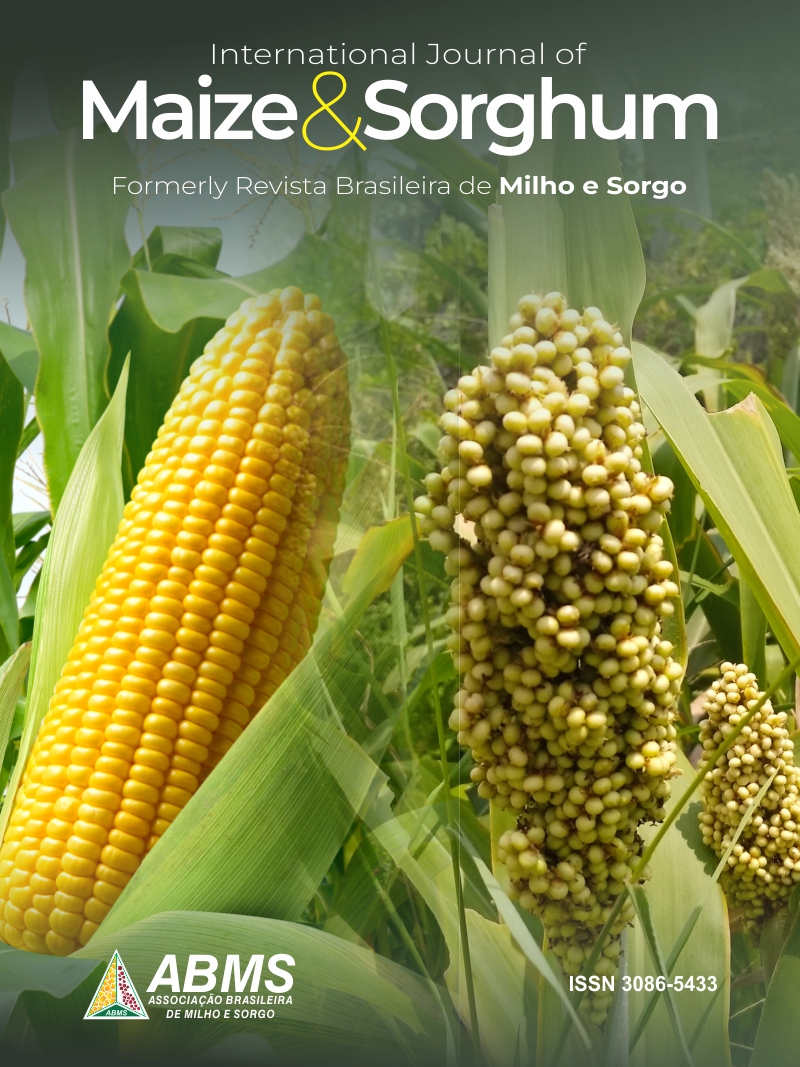
Corn areas in Southern Brazil are generally managed without cover crops during the offseason, which can compromise both soil quality and the crop’s productive efficiency. Furthermore, different corn hybrids may show distinct responses to management conditions, making their evaluation essential for proper recommendation to growers. Therefore, this study aimed to evaluate the effects of cover crops on the development, yield, and total operational cost of corn hybrids. The experiment was conducted in a randomized block design with four replications, in a 4 x 2 factorial scheme consisting of four corn hybrids (AS 1800 PRO3, DKB 242 PRO4, FS 395, and MG 377) and two cover crop mixes composed of grasses and legumes (RX 330 and RX 340). The crop yield components analyzed were: plant height, ear insertion height, chlorophyll content, leaf area, leaf area index, number of kernels per ear, thousand-grain weight, yield, and total operational cost. There was an interaction between hybrids and cover crops for traits such as plant height, thousand-grain weight, and yield. The results demonstrated that the mix with a higher presence of legumes provided higher yields for the AS1800 PRO3 hybrid, while the mix with more grasses resulted in higher yields for the FS 395 hybrid. The highest economic return was not associated with the treatments with the lowest operating costs, but rather with the corn hybrids that achieved the highest grain yields. The interaction between cover crops and genetic material influences corn yield and profitability in the Extreme South of Santa Catarina.
Downloads
Published
Issue
Section
License
Copyright (c) 2026 Luís Augusto de Souza Velho, Eliete de Fátima Ferreira da Rosa, Marcos André Nohatto, Paola Oyarzabal Siqueira, Steffani da Luz, Luiza Fernanda Erdmann

This work is licensed under a Creative Commons Attribution 4.0 International License.
Authors retain copyright and grant the journal right of first publication with the work simultaneously licensed under the Creative Commons Attribution License that allows the sharing of work and recognition of the work of authorship and initial publication in this journal.
Authors are able to take on additional contracts separately for non-exclusive distribution of the version of the paper published in this journal (eg, in an institutional repository or publish as a book), with acknowledgment of its initial publication in this journal.
Authors are permitted and encouraged to post their work online (eg, in institutional repositories or on their website) at any point before or during the editorial process, as this may leadto productive exchanges, as well as increase the impact and citation of published work.