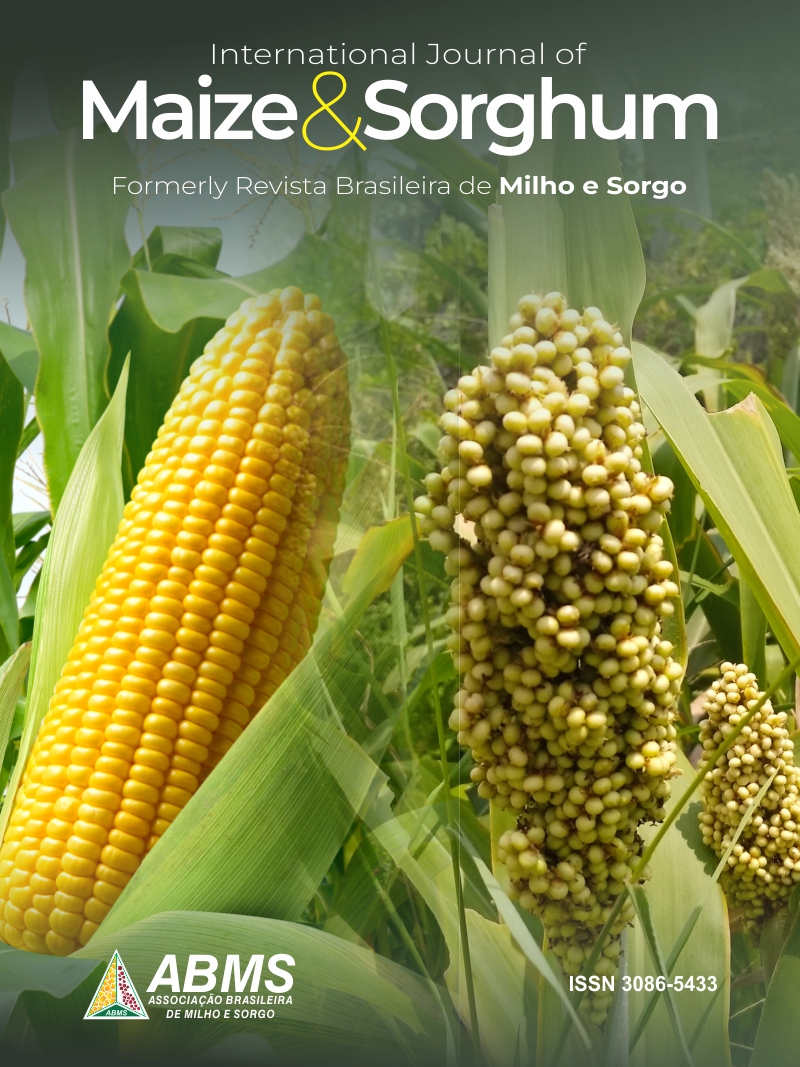
PREDICTION OF THE NUTRITIONAL VALUE AND IN VITRO DIGESTIBILITY OFFORAGE PRODUCED BY DIFFERENT MAIZE HYBRIDS
DOI:
https://doi.org/10.18512/ijms2026e1375Abstract
Estimating the nutritional value and in-vitro digestibility of forage is important both to support adequate feeding management of forage based and to guide genetic improvement programs. In this context, the present study aimed to evaluate the yield and estimate the nutritional composition and in-vitro digestibility of the forage produced by different maize hybrids. The experiment was conducted under field conditions during the 2023/2024 crop season in the municipality of Colorado do Oeste, RO, Brazil. The experimental design was randomized blocks, composed of twelve maize genotypes (HLX2277 CO, HLX2162 CO, FS620PWUCO, B2433PW CO, P3016VYHR CO, HLX2124 PRO3, HLX2104 PRO3, HL2065 PRO3, SHS7990 PRO3, SHS7970 PRO3, BM3069 PRO3, BM3066 PRO3) and three replicates. At the phenological stage of grains with a farinaceous aspect, the whole plant was harvested and the dry mass was chopped, crushed and sent for bromatological analysis. At physiological maturity, ten representative ears were sampled per plot to determine the production components. The hybrid HLX2162 CO stands out in plant height, kernel rows per ear, kernels per row, and grain yield. Additionally, it exhibits the highest levels of water-soluble carbohydrates and higher in vitro NDF digestibility in the forage, making it recommended for the evaluated edaphoclimatic conditions. The forage from the different corn hybrids shows high coefficients of in vitro dry matter digestibility and NDF digestibility, with average digestible and metabolizable energy contents of 3.10 Mcal.kg-1 and 2.68 Mcal.kg-1, respectively, corrected to 90.17% dry matter.
Downloads
Published
Issue
Section
License
Copyright (c) 2026 Lucas Rafael Santos Molina, Érica de Oliveira Araújo, Niraldo Muniz de Sousa, Jhonathann Willian Furquin da Silva, Túlio Orloski de Castro Pereira, Eduardo Miranda Ferreira Silva, Gabriel Monteiro Paulino

This work is licensed under a Creative Commons Attribution 4.0 International License.
Authors retain copyright and grant the journal right of first publication with the work simultaneously licensed under the Creative Commons Attribution License that allows the sharing of work and recognition of the work of authorship and initial publication in this journal.
Authors are able to take on additional contracts separately for non-exclusive distribution of the version of the paper published in this journal (eg, in an institutional repository or publish as a book), with acknowledgment of its initial publication in this journal.
Authors are permitted and encouraged to post their work online (eg, in institutional repositories or on their website) at any point before or during the editorial process, as this may leadto productive exchanges, as well as increase the impact and citation of published work.