GRAIN YIELD OF MAIZE GENOTYPES UNDER FULL AND SUBOPTIMALIRRIGATION
DOI:
https://doi.org/10.18512/ijms2026e1370Abstract
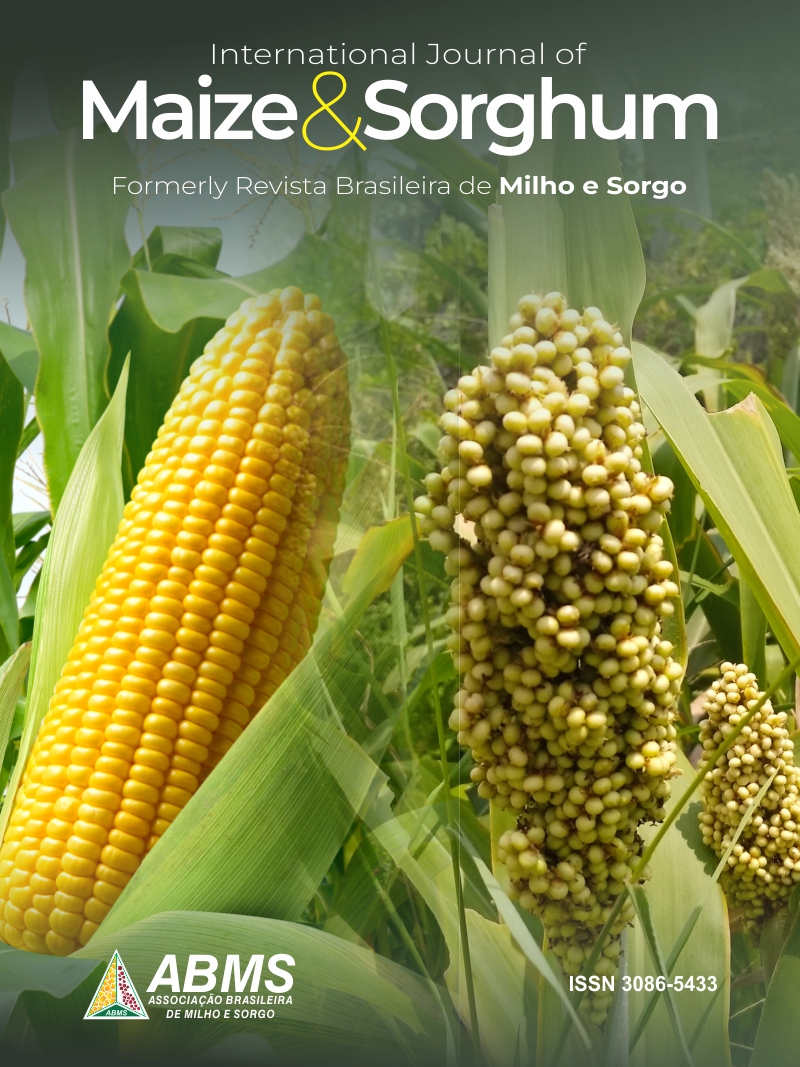
The water stress resulting from irregular water availability is one of the main factors limiting maize (Zea mays L.) productivity in the Brazilian Cerrado. This study aimed to evaluate the phenological and yield performance of maize genotypes under different irrigation depths using a line-source system to induce a gradient of water stress. The field experiment was conducted at Embrapa Maize and Sorghum, Sete Lagoas, Minas Gerais, Brazil, from April to October 2024. Eight maize genotypes were evaluated under irrigation depths ranging from 194 to 579 mm in a randomized block design with four replications. Water deficit significantly shortened the phenological cycle, advancing physiological maturity by up to 20 days, whereas full irrigation prolonged the cycle and enhanced grain filling. Average grain yield ranged from 2,100 to 8,900 kg ha⁻¹ across the irrigation depths applied throughout the crop cycle. The hybrid 3S 2761 exhibited the highest grain yield, while 1P2216VTPRO2 showed greater earliness under water stress conditions. Increasing irrigation depths promoted gains in harvest index (0.12 to 0.5) and thousand-grain weight, reflecting improved assimilate partitioning. Maximum water productivity was observed within the range of 470 to 500 mm, indicating greater water-use efficiency. These results demonstrate that irrigation management based on optimizing applied water depth is a valid strategy to maximize yield and water-use efficiency in tropical irrigated maize systems.
Downloads
Published
Issue
Section
License
Copyright (c) 2026 Anna Thereza Lima Alves, Camilo de Lelis Teixeira de Andrade, Júnia de Paula Lara, Roberto dos Santos Trindade, Paulo Evaristo de Oliveira Guimarães, Antônio Carlos de Oliveira

This work is licensed under a Creative Commons Attribution 4.0 International License.
Authors retain copyright and grant the journal right of first publication with the work simultaneously licensed under the Creative Commons Attribution License that allows the sharing of work and recognition of the work of authorship and initial publication in this journal.
Authors are able to take on additional contracts separately for non-exclusive distribution of the version of the paper published in this journal (eg, in an institutional repository or publish as a book), with acknowledgment of its initial publication in this journal.
Authors are permitted and encouraged to post their work online (eg, in institutional repositories or on their website) at any point before or during the editorial process, as this may leadto productive exchanges, as well as increase the impact and citation of published work.